I wanted to get an early start with my side projects and extracurriculars at Duke. I was immediately drawn to the Innovation Co-Lab, a network of makerspaces where students can explore modern techniology and be creative with their projects. With an interest in VR, I applied to be a 'VR Tour Guide' at the Co-Lab VR Studio (then known as the Multimedia Project Studio, or MPS), where not only could I learn and explore this tech that I had limited access to growing up, I would also showcase its capabilities to the Duke community.
However, lab managers Dave and Felix had other plans for me. Before my interview, I had heard about a VR treadmill they had in storage. I let them know that I was very interested in exploring technology like that as well, as I always loved integrating hardware peripherals to my gaming experiences. Instead of a VR Tour Guide, they welcomed me to the team as the Hardware Integrator, a developer positon focused on breathing new life into the stored, dormant, and sometimes unused hardware peripherals at the lab. I was eager to test the possibilites of additional hardware and to experience how they could enhance the VR experience.
Overall, I evaluated two peripheral ecosystems: the Kat Walk C 2+ and the VIVE Tracker 3.0. Both of these focused on adding more body movement to the VR experience, with the final goal of increasing physical activity, immersion, and potentially reducing motion sickness, one of the greatest problems in VR yet to be fully solved.
Kat Walk C 2+
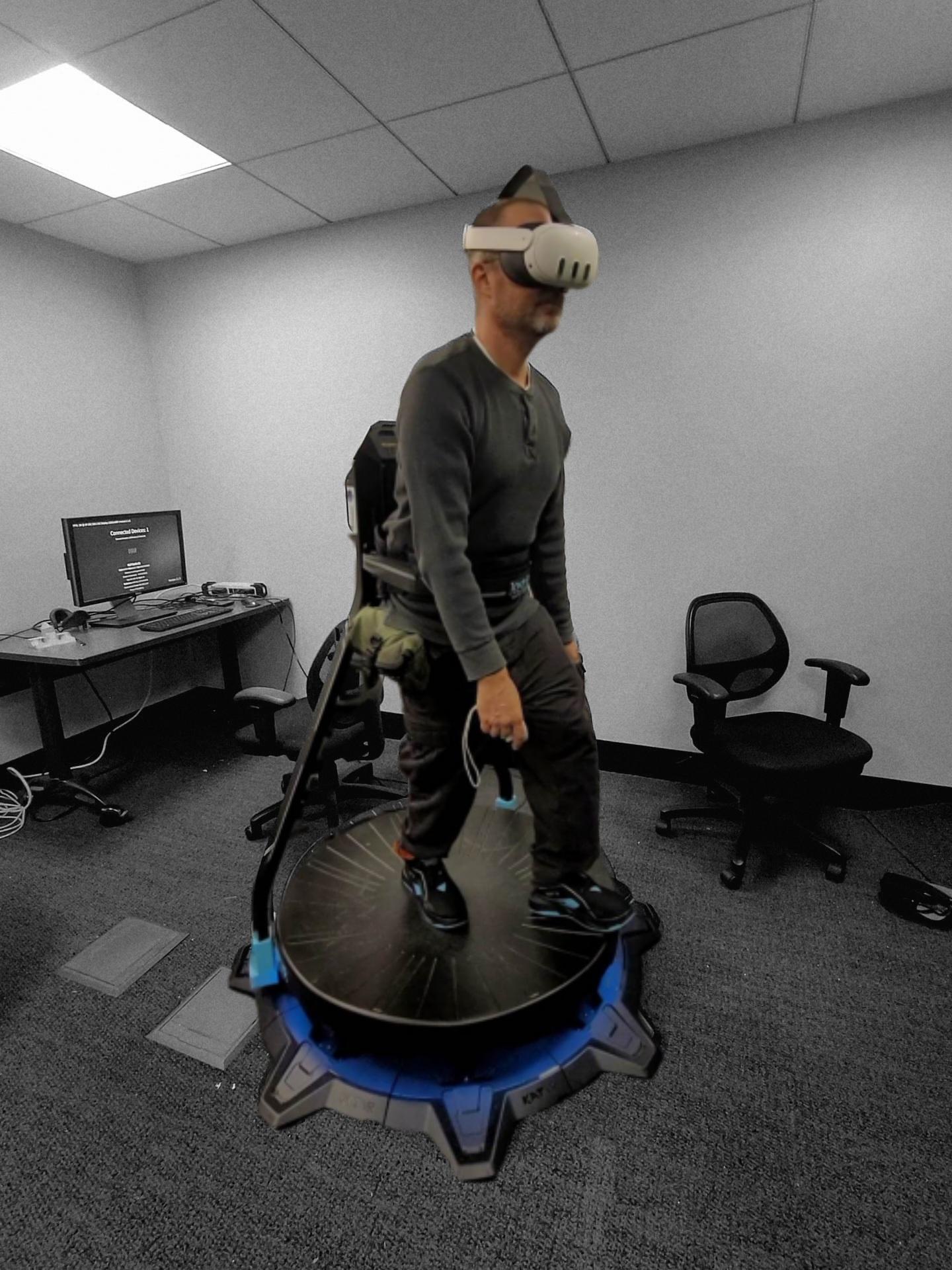
The Kat Walk C 2+ VR Treadmill looks anything but. While it may not resemble a treadmill in the traditional sense, it functions like one in that it will keep you rigged to one spot and allows you to walk in place. Optical sensors in the shoes send the movement input to the headset. Pictured above is Dave Zielinski testing the Kat Walk C 2+ for the first time.
VIVE Tracker 3.0
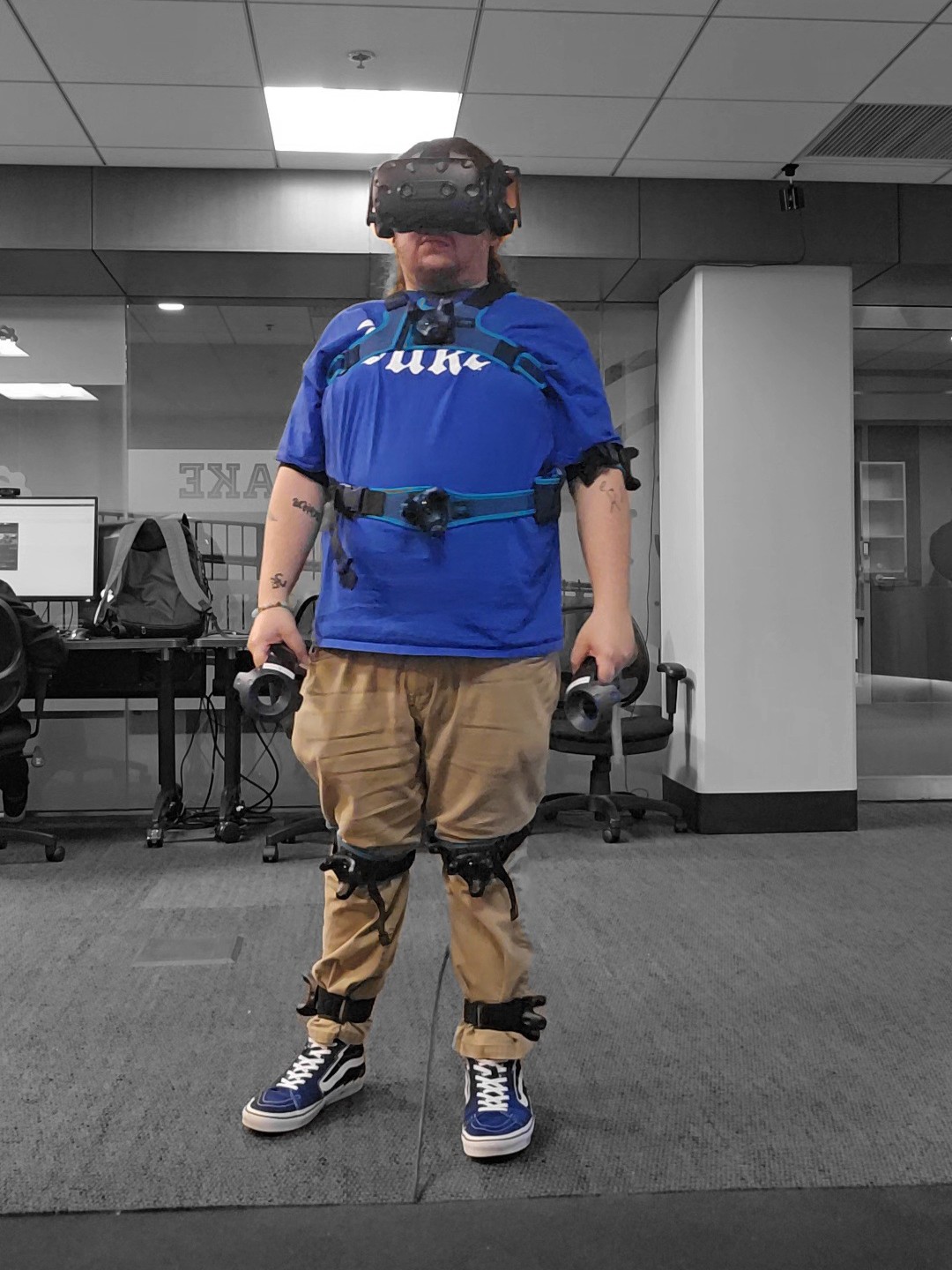
The VIVE Tracker 3.0, affectionately known as the "Puck", is a tracking sensor that is attached to all crucial extremities and joints to fully translate a whole body into the VR Experience. Pictured above is myself using an HTC VIVE Pro 2 while wearing eight trackers on my chest, waist, elbows (2), knees (2), and ankles (2). Eight trackers paired with two controllers and a headset forms a full 11-point tracking system, which is widely regarded as the best and most efficient method of Full-Body Tracking.
Development Process
Although they encompass very different use cases, both my Kat Walk C 2+ and VIVE Tracker 3.0 evaluations were carried out in similar fashion. Both devices were tested rigorously to look for how it could improve the VR experience. No stone was left unturned and all conclusions came after exhausting all possibilities. Here is how each device fared.
Kat Walk C 2+
After setting aside a side room in the VR Studio, the treadmill was built and I began some lengthy testing. We wanted to see how the treadmill would fare in different network conditions, with different devices, and while being used by different people, among many more tests. While the treadmill was built to be used with direct-to-PC headsets, KatVR provided a device that allowed the Meta Quest to interface with the system in Standalone mode. This was our first ideal test, as we believed the experience would be best when completely untethered. We were especially excited to test the device because KatVR claimed that the use of a VR Treadmill worked toward reducing motion sickness.
It is widely known that motion sickness in VR is a common problem that can be induced, among other things, by the difference between one's motion in a virtual space from their motion (or lack thereof) in the real space. While the Kat Walk C 2+ ed at bridging this gap, its sensors and software are still rudimentary and can sometimes worsen the experience with false positives and negatives. While some testers reported a reduction in motion sickness, others reported an increase. We tested all sorts of configurations: wired networks, wireless networks, firewalled networks, unprotected networks, wired PC connections, wireless HMD connections, and the many settings within the Kat Gateway software. None of which solved the fundamental problem of imperfect movement translation.
Even if at times it worked like a dream, we didn't feel confident enough to introduce this technology to the Duke community. I documented my findings and left the project in the hands of a future Co-Lab VR Studio developer. Hopefully they can breathe new life into the Kat Walk C 2+ with a little R&D.
VIVE Tracker 3.0
The tracker ecosystem was easier to set up, as it uses the same external tracking system as the Vive Pro 2 (the Base Station 2.0, a.k.a. the 'lighthouses'). Since we had the resources, we maximized our testing it all the way to an 11-point tracking system immediately. Similar to the treadmill testing, we wanted to test the trackers with a tether-free setup using the Meta Quest. However, since the trackers worked through SteamVR, we opted to test several wireless PC connections like AirLink or Virtual Desktop rather than something standalone.
Since the Meta Quest and the trackers used completely different tracking systems, some additional tools and plugins were necessary. Namely, we used an add-on called Space Calibrator, which allowed both Quest and Vive devices to connect simultaneously. This was a good first step, but having two different tracking systems that didn't talk to each other was a cause for frequent drifts and desyncronizations. Every time a user wanted to use the trackers, they would have to remove one from the body accessory, hold it in the same hand as a Quest Touch controller, and perform a manual callibration by making a figure-8 motion for about a minute.
Luckily for us, Space Calibrator had recently added a feature to mend this problem: Continuous Callibration. This allowed for the Vive base stations to track the Quest headset by attaching a spare Vive tracker with a 3D-printed accessory. This worked like a charm, and we were able to test the trackers using VR Chat, to see if they could make virtual avatars more expressive. We concluded that the trackers were a success, and I left the project after graduating, but not before being ensured that they will become a regular part of the VR Studio demo experience.
Key Takeaways
- The Power of Addition in VR - At its simplest, Virtual Reality can already transport us to a new world using only a headset and two controllers. These commercial devices that I evaluated allow for a more active experience that can allow users to feel like they can go beyond simple interactions. In terms of diving, if using a standalone Meta Quest is like snorkeling, adding body trackers or a treadmill is like the full scuba experience (provided the conditions are ideal).
- The Risks of Imperfection - While perfect conditions allow these devices to enhance the VR experience, any deviation can not only bar the experience from improving, but it can hinder it severely. It is always a risk to indulge in these emerging technologies, but I believe the successes make it all worthwhile (especially if it can lead to future device updates and releases).
Duke Innovation Co-Lab VR Studio Website